
Close your eyes for a moment.
Take a deep breath and ask yourself one question.
Are you happy? Not fine, not getting by, but truly content with your life.
Sit with that thought for one moment.
Now, open your eyes.
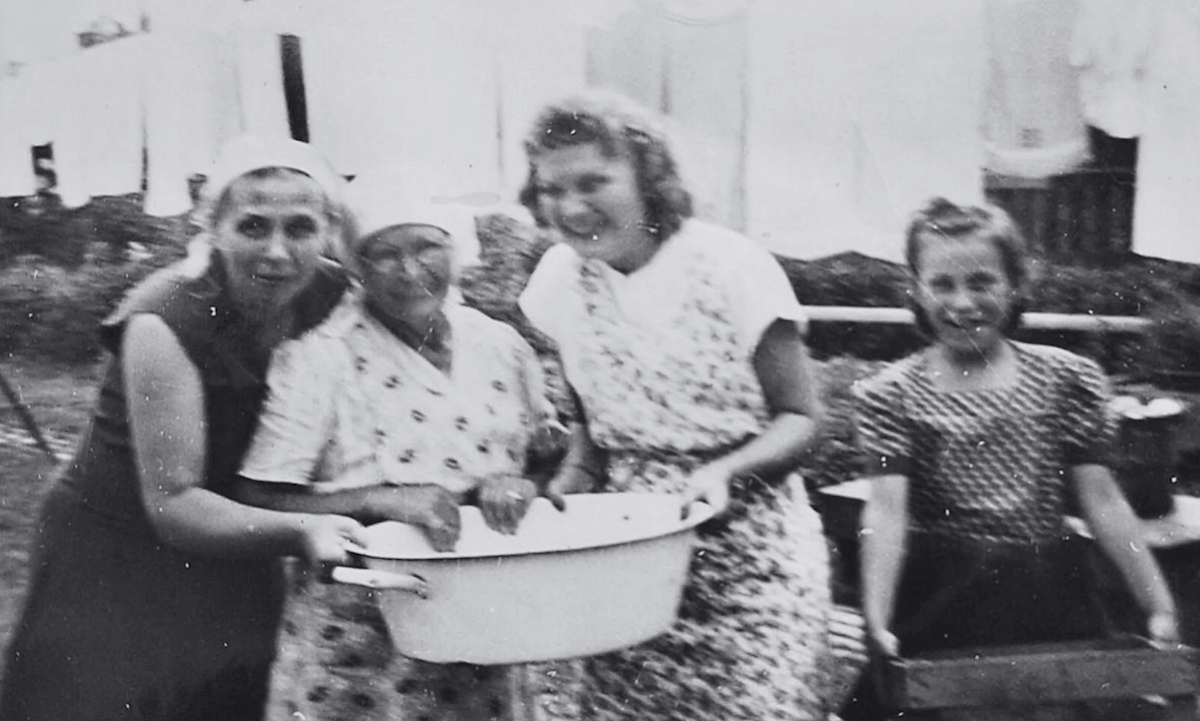
When you see photos like this, you’ve got to notice those are real smiles.
This is 80 years ago.
And these smiles are not for Instagram.
This immigrant family, my family, is enjoying an afternoon washing laundry and canning tomatoes in their backyard.
There’s no fancy equipment, no convenience, just hard work and some laughs.
Yet, there’s something unmistakable about their expressions.
They look so joyful.
It’s a striking contrast, isn’t it? By any material standards, these women had far less than we do today.
Less money, less security, virtually no access to health care.
Scarcity was a constant companion from food to clothing to basic comforts.
Yet in this photo, they radiate happiness.
Fast forward to today.
As a society, we have more than these women ever could have dreamed of.
instant access to food, cutting edge medicine, and comforts they’d consider luxuries.
Yet, paradoxically, we’re unhappier than ever.
In the United States, happiness has hit historic lows.
Only 14% of people indicated they were very happy in 2020, down dramatically from just a few years before.
So, what happened? How can we live in an age of unparalleled abundance but feel so empty? Could it be that our modern lives are missing something the women in these photos inherently knew? Is it possible that today we’re experiencing a crisis of gratitude? Well, let me take you back to 2020 when the world was in chaos.
I was the CEO of a data science company that year trying to grow my company.
I was also the mom of two young kids trying to navigate lockdown homeschool.
Let me tell you, I have never wanted recess more than I wanted it that year.
I thought I was being a good mom because I’d always play hide-and-seek with my kids.
But there was one catch.
They didn’t know that we were playing.
And somehow they found me and usually under two minutes hiding in the pantry with a bag of chips.
We can laugh about it now, but at the time the world was living in fear of the many things that we didn’t know about CO 19.
And after that year was over and I had slogged through the challenges, the stress, the emptiness of the pandemic, it hit me.
How can I live in a time where I have more than my grandmother ever could have dreamed of, yet somehow I’m unhappy? That’s when I started an experiment.
The central theme of this experiment was I needed to pay attention to the little things in my life that were good.
The premise of this experiment was very simple.
It just had three rules.
Think of 10 things you’re grateful for.
Write them down.
Do it every day.
And I did that for one year.
The outcome of the experiment.
Well, during that year, my life and my happiness took a remarkable turn for the better.
I sold my company.
A new business opportunity came up that was literally a dream come true.
Meaningful changes started to happen with my relationships.
It was like my life up until that point was an old, rusty machine slowly squeaking along.
But this new mindset of gratitude was adding grease to those cogs and gears that made it run more efficiently than I ever could have imagined.
Gratitude didn’t make my problems disappear.
That’s the interesting part, but it gave me a new lens to see my problems through.
Instead of feeling overwhelmed by everything that was going on, I started to notice what was still good, still beautiful, still worth celebrating.
I started to research gratitude’s impact on our physical and mental well-being and learned that something as simple as writing down the things that you’re grateful for every day has been proven by hundreds of studies to improve our health, our happiness, and even our longevity.
There’s a study by UC Berkeley that showed that people who practice gratitude had stronger emotional strength, stronger relationships, and even better physical health.
One study out of the University of California found that writing thank you letters reduce symptoms of depression and anxiety for months after the practice ended.
Research has shown that gratitude literally rewires your brain.
Neuroplasticity research has showed that people who practice gratitude shift their mental patterns, training their brain to see the positives more automatically.
Over time, you’re not just practicing gratitude, you’re living it.
Gratitude has been proven to improve your immune system, lower blood pressure, and even improve sleep quality.
Why? Because when you focus on what you’re grateful for, your stress levels drop, and your body heals.
But here’s what’s really fascinating.
Gratitude isn’t good just when life is good.
It’s most powerful when life is hard.
Dr. Robert Emmens, the world’s leading expert on gratitude, has described it as an indispensable tool for resilience.
When you practice gratitude, you’re not denying your struggles.
You’re choosing to see the silver linings, the lessons, those tiny glimmers of hope.
And that choice gives you strength.
In my case, it helped me to navigate the chaos of a pandemic while raising two kids.
But the thing that I could not get over is as the founder of a healthcare data science company, how did I not know about this profound tie between gratitude and well-being after looking at health data for years? Why did I not know this? Well, it turns out there’s this thing called the complexity bias, or as regular people like me call it, overlooking the obvious.
This is why we overlook simple things like getting enough sleep, drinking enough water, and surprise, being grateful for the things you already have.
We overlook the simple solutions and tend to value the solutions that are more complicated to understand.
Case in point, we’ll spend an hour debating over whether almond milk or oat milk is healthier, completely ignoring the fact that we’re pouring it into a triple caramel latte.
So all of this brings us to the second part of my experiment to go beyond the data and to hear firsthand stories from other people about their experience with gratitude.
To do this, I did something I never thought that I would do.
I started a TikTok channel.
Yes, me, the mom of two who thought that TikTok was either a clock app or the sound my knees make when I get up too quickly.
But yes, TikTok is an amazing platform.
Its users spend more time per session than users on any other platform.
Why? Because of its advanced AI, which predicts user preferences with astonishing accuracy.
In other words, it’s very good at offering up content that matches people’s interests.
But the best thing that I found about TikTok was the realness, the sincere authenticity of the discussions.
I began posting my videos every single day about my year-long experiment, writing down the things I was grateful for and the lessons I learned along the way.
I didn’t expect much, but what happened next was extraordinary.
People started to share their own gratitude lists and they started telling me how gratitude was changing their lives as well.
Tens of thousands of people joined the conversation.
People from all sorts of backgrounds and spiritual traditions from all over the world.
They told me stories of getting sober, recovering after losing loved ones, and rebuilding their lives after traumatic setbacks.
Through Tik Tok, I met people whose resilience humbled me.
I met Amanda, a woman navigating a painful divorce, who told me writing down the things she was grateful for every day gave her hope in moments she never thought she would feel joy again and the strength to rebuild her life.
and Adam, a therapist, who told me after his failed attempt at taking his own life, his family rejected him and cut off all communication.
He told me, “Even after losing everything, gratitude showed me there’s still so much beauty left to live for.” One night after one of my TikTok live events, I met someone named Donnie.
He told me the story of the day that he had a massive stroke and lost function in half of his brain.
This resulted in him losing his job, his home, and his marriage.
At the beginning of his long road to rehabilitation, Donnie realised that he had a choice.
He could spend the rest of his life mourning what he had lost.
Or he could move forward and focus on everything that was still good.
He decided that he was going to be the example that no matter what life throws at you, even when you lose everything, you can still find something to be grateful for.
Donnie told me that gratitude helped him to accomplish something truly extraordinary.
He wrote a book about how he overcame this unimaginable setback.
He even did a TEDex talk and he too speaks about his story on TikTok to show people that they can find the good in every day too.
I want to take this moment to recognise Donnie for his incredible strength.
There’s no day that’s easy, but he shows up every day.
He is a living example that no matter who you are, no matter what you’ve been through, everyone can find reasons to be grateful.
My own TikTok channel on the power of gratitude touched my heart in so many ways.
Every day I’d read the comments on my morning walks and even on the days when I was feeling my lowest, there was always a beautiful community of people who were there lifting me.
One day after posting a video, someone commented, “What happened happened and couldn’t have happened any other way.” And I responded, “Wow, that’s really deep.
Is this a quote by Buddha?” and he said, “Thanks.
It’s by Morpheus from the Matrix.” The biggest mind shift is that practicing gratitude is so simple yet so profound.
Gratitude connects us and reminds us that we’re part of something bigger.
It’s not a world of me.
It’s a world of we.
And when we can come together and claim radical ownership over our stories, we can understand that gratitude doesn’t just make life feel better.
It gives life meaning.
Gratitude is about seeing the hidden gift in each moment and event in your life, even the ones that broke you.
Gratitude isn’t about glossing over pain.
It’s about mining for gold.
And if we lean into it, we can realise that gratitude is alchemy.
It replaces loss and turns it into wisdom, pain into resilience, and ordinary moments into miracles.
So, how can you make gratitude part of your life? Start small by following these simple rules.
Write it down.
Every day, take a moment to write some things down that you’re grateful for.
Big or small, it doesn’t matter.
What matters is consistency.
Feel it.
Don’t just write the words.
Take a moment to feel the gratitude in your heart.
Share it.
Gratitude grows when it’s shared.
Tell someone why you appreciate them or invite someone to join you in this practice.
Be patient.
Gratitude is a habit and like any habit, it takes time to build.
But I promise the more you practice, the more natural it becomes.
The big idea I want to leave you with is that gratitude is not just a feel-good practice.
It’s a superpower.
Gratitude connects us and shows us that we are part of a bigger world.
So today, ask yourself, what are you grateful for? Write it down.
Speak it out loud.
Share it with someone else.
When we choose gratitude, we don’t just make our own lives better.
We create a ripple effect that transforms the lives of others.
And what could be more beautiful than that?
[Applause]